Showing posts with label cast iron. Show all posts

Tuesday, April 20, 2010

Other People's Food 101: The Bread that Changed Everything

Remember how in my first few posts, I pretty much said I hate baking.


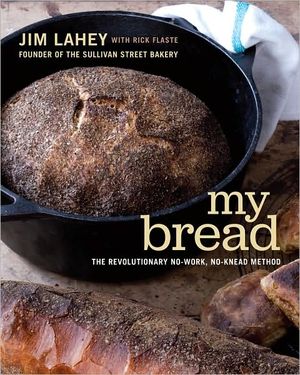
I still do. I just hate it a lot less, and it's fully because of this book:


Figure 17.B-2 If I had a summer reading list for you guys, this would be on it... that gives me an idea for a post!

I've been churning out loaf upon loaf of crusty, flavorful bread with a soft, tender crumb that would impress even the octogenarian Italian bakers back home. I'm happy to provide you guys with the formula and technique for this little food revolution, courtesy of the man who wrote the book:

Sullivan St. Bakery Bread Recipe - This is a little bit modified than the original technique in My Bread, but it's the same principle. Plus, I'm not breaking any copyright laws by posting this link.

A couple caveats: 1) although it may look cumbersome and drawn out (particuarly the 18 hour rising time), this recipe is stunningly easy. You mostly ignore the bowl of dough on the counter and go about your normal life while it does it's own thing, then chuck it in the oven for less than an hour. 2) I use a plain, seasoned cast iron pot like is shown on the cover of My Bread, primarily because I can't afford the Le Crueset he recommends. Plain cast iron, well cared for, works fine.

Tuesday, December 1, 2009

Meat 101: Braised Short Rib

Thanksgiving break is over, back to the learnin'.

A couple of months ago, my girlfriend and I went on a short vacation to Burlington, VT. I had spent a month there on an audition rotation for a neurology program, and then we had gone in 2008 for a short weekend away. Needless to say, I'm pretty familiar with Burlington, but prior to this last vacation I had never been to Trattoria Delia, and had never eaten wild boar (Figure 8.a).

Figure 8.a - The noble and apparently delicious wild boar. (http://www.linburnes.org/)

They served it braised, pulled apart and tossed with heavy, hearty roman gnocchi. It was an amazing meal to be had on a freezing Vermont evening. The problem with knowing how to cook is that every time you sit down to a meal, you think "I could do that." Not willing to buy wild boar meat online and have it shipped across the nation (my mom always told me never to pay more than $1.99/lb for meat, a truth I've held to for the majority of my adult life) but wanting to re-create the dish I loved so much from my vacation, I set off to the grocery store. I was armed with a knowledge of cuts of beef, their relative flavors, and the application to use them in (Figure 8.b).

Figure 8.b - I like this chart because it reminds me of the periodic table. (http://fornaturalfood.com/)

Braising is a form of slowwwww cooking, so its ideal piece of meat is one that is as flavorful as possible, tenderness be damned. It's the same reason stores sell super-tough chuck all cut up for stew - by the time you're done simmering it, it will be as tender as... well... use your imagination. That day, I ended up with a package of boneless short rib that they were selling on the cheap. I already had the other essentials for braising at home (Figure 8.c) - a dutch oven, plenty of wine, black pepper and salt. So I set to it, and here we are to reap the fruits of my experimental labor.


Figure 8.c - Braising essentials, in no particular order.

Braised Short Rib

  • One or two pounds of boneless beef short rib, or three to four pounds of beef short rib on the bone, depending on how many people you plan on feeding and how long each of you plans on eating left overs. The key here is to at least double up on the pounds if you're buying your meat on the bone. Any meat with bones is arguably more flavorful than without, but do what you want.
  • One or two big glugs of olive oil.
  • A large onion, cut into half-rings.
  • Enough black pepper to slightly surpass your comfort level.
  • Half a hand full of sea salt or kosher salt.
  • A bottle of red wine that you like - I pictured Pinot Noir because that's the only one I had on hand tonight. For the initial recipe, I used an old vine zinfandel. Feel free to use Cabs, Chiantis, Super-tuscans, et cetera.
  • (Optional) A couple of sprigs of fresh rosemary.
  • Two big pats of butter -or- two more big glugs of olive oil.
  • Half and hand full of all purpose flour.

Preheat your oven to Bake 275. That's right. Not the universal bakers' 350, 75 degrees less than that. Coat the meat with salt and pepper. Place the oil, the onions and your short rib in a dutch oven. I use plain cast iron, the enamel ones work fine too. You can use any pan with a cover that you can put on the stove top and the oven without it melting. Brown the meat on all sides well on medium high heat.

Pour yourself a glass of wine. After the meat is done turning brown and tasty, pour the rest of the bottle of wine into the pot. Add the rosemary, if you're using it. Scrape what ever's stuck to the bottom up with a wooden spoon. Cover the pot/pan/earthen vessel/whatever and place in the oven. Let it simmer (i.e. braise) for two or three hours. Honestly, the longer you let it sit, the more tender the meat will be.

Finally, take the pot out of the oven. Scoop the meat out (leave the onions in), put it on a plate and cover it with tin foil. Return the pot to the stove top, and turn the heat up to high. Let the braising liquid (wine + meat juices = braising liquid) bubble away until it's about half way reduced. In a seperate pan, let your flour heat in a dry pan until it starts to turn gold-brown. Add in your butter or olive oil and whisk aggressively (butter + flour + heat = a roux). Take a scoop of your reduced braising liquid and whisk it into your roux, then return the whole thing back to the original pot. Reduce your heat to medium and stir, it will become drastically thicker. Return your meat to your newly formed gravy and toss it around. You can either serve it just like that, or pull it apart and toss it with pasta Vermont-wild-boar-style.

Hope you enjoyed today's installment, be back next week with more winter season food.

Tuesday, October 20, 2009

Cookware Special Seminar: Heirloom Cast Iron

Somehow, we have rural medicine to blame on this one.

Back during my rural medicine rotation in November 0f '07, I cooked for the other five medical students at this remote clinic site in Whoknowswheresville, Pennsylvania. I used cast iron for the first time, and it was badass. In the intervening two years, I would always swing by the pot and pan isle of what ever chain department store I happened to be in. It usually ended up only being a short visit due to a 1) lack of cast iron in stock on the part of the store and 2) a lack of capital on the part of my bank account. I eventually broke down and bought a preseasoned cast iron dutch oven. I will admit, it's care was a little bit more than I expected, but I use it constantly for roasts, soups, polenta, really any application that fits the size of the pot both on the stovetop and in the oven.

Flash forward to these past two weeks. First, I went to visit my parents. They are Italian, so I always leave their house with more stuff than I showed up with. During the visit in question, I left with one 4 quart cast iron chicken fryer and two long, shallow edge baker/broilers. They weren't in the best condition. My girlfriend catches wind of this, and offers me her late grandmother's cast iron 4 quart fryer and two skillets. Feast or famine, folks. I went to having no cast iron pans to having SEVEN in the course of 2 weeks. Most of them severely needed attention (Fig. C.1)


Figure C.1 - Cast Iron after lots of soap, and 20 some-odd years in a basement.


Before I would be making some badass corn bread or paella or something, I had some work to do. I did a lot of research, and some trial and error. Here is what I came up with:


Tony's Foolproof Method for Restoring Heirloom Cast Iron Cookware


This whole process takes up about half a day, so have other stuff around the house planned, as your oven will be on mostly the whole time and therefore poses a fire hazard.


  1. Examine your new old cast iron. If there is too much black stuff caked on, or if there are spots of rust, proceed to Step 2. If you're just skeeved out by using someone else's pans, proceed to the next step. If your new old pan has a non-crusty black layer on it, and you don't care what other people have been eating, proceed to Step 7.


  2. Place your pots and pans upside down in your oven and set it to automatic clean mode. This will get pretty much everything but the rust off of your pans. It will also take like 3 hours, so get a book or a video game or something. Depending how much crap is on your pan, there will be a lot of smoke. Open some windows and fire up some fans.


  3. Using a stainless steel scouring pad, scrub the crap out of the pan. Once the rust is off, you should see bare gray iron staring back at you. This is good. Dry them off with a rag you don't care about ruining, but is clean enough for you to use on a pan you'll eventually be eating with.


  4. Put the naked pans right-side-up into the oven at 325 Farenheit for 10 minutes and make sure they're dry. Any water left on the pans will cause more rust, and you'll be back to step 3.


  5. Once dry, rub a medium layer of solid cooking fat onto the hot pan. I use Crisco, because I'm poor. I have read of other people using rendered (read: left over after cooking) bacon fat, lard or any number of other solid-at-room-temperature fats. Put your greasy pan back into the oven, up side down again and let this first layer of "seasoning" bake on for one hour. "Seasoning" in this sense does not mean tasty things like black pepper or sage or Zesty Italian. It is just a layer of fat that keeps your pan from rusting and food from sticking to your pan while cooking with it.


  6. After one hour in the oven, take the pan out and repeat steps four and five once or twice more to get a good base of seasoning on the pans. After 2-3 coats of seasoning, it's okay to transition to vegetable oils for any baked-on seasonings you use. Avoid olive oil, as it has a relatively low smoke point, unless you enjoyed airing out your house in Step 1. After at least two coats, your pan should have a fine black finish to it (Figure C.2).


  7. After each use, scrub the pan with a stiff-bristled brush. I use a bamboo brush I bought in some kitchen store in Vermont that I can't find the website too. Plastic bristles are fine too. The important thing is to NEVER USE SOAP, unless you want your pans to look like Figure C.1. After scrubbing, dry thoroughly with a dish towel (mapine!). Rub the inside of the pan with a thin coat of vegetable oil while it's still hot from the water. It's safe to use olive oil here, as the smoke point doesn't matter. You're not going to heat the pan again until next time you cook with it. If there is a lid, put a piece of paper towel between the lid and the pan when you store it, and keep the lid a little off kilter from the pan. The seasoning needs air to be able to drift by.


Figure C.2 - Cast iron after Tony's Fool Proof Method for Restoring Cast Iron Cookware
Class dismissed.